Industrial Salad Processor’s: Surviving the Fresh-Cut Evolution
In high-volume, ready-to-eat food service processing, margins are devoured by three factors: manual labor dependencies, product yield waste, and recall risks.
The companies dominating the global salad market don’t gamble on trendy, untested machinery gimmicks. They build on fundamental, time-tested engineering to scale seamlessly.
Here is why investing in advanced, automated robotic de-coring systems and large-scale fresh food processors is the only logical path to keeping your facility profitable, secure, and resilient.
1. Eliminating the Vulnerability of Human Labor
Relying on teams of workers standing on a line with manual knives is the single greatest vulnerability in your processing plant today.
Every human hand that touches a head of lettuce introduces an unpredictable variable into your business: fatigue, physical injury, labor shortages, and cross-contamination.
Automated robotic systems replace this outlook with absolute consistency. A robotic cutting cell doesn't slow down on hour ten of a shift, or call in sick.
By anchoring your facility to an automated baseline, you secure a fixed, unshakeable operating cost that guarantees high through-put, even when the labor market fluctuates.
Transitioning to automation transforms an unpredictable operational variable into a predictable, fixed capital asset.
2. Surgical Precision Over Costly Product Waste
Every ready-to-eat processor knows that losing even a small percentage of a lettuce head to sloppy manual coring, results in massive amounts of lost revenue annually.
Manual de-coring is a guessing game that routinely slices away valuable, saleable product or leaves bitter core material behind…….resulting in recalls.
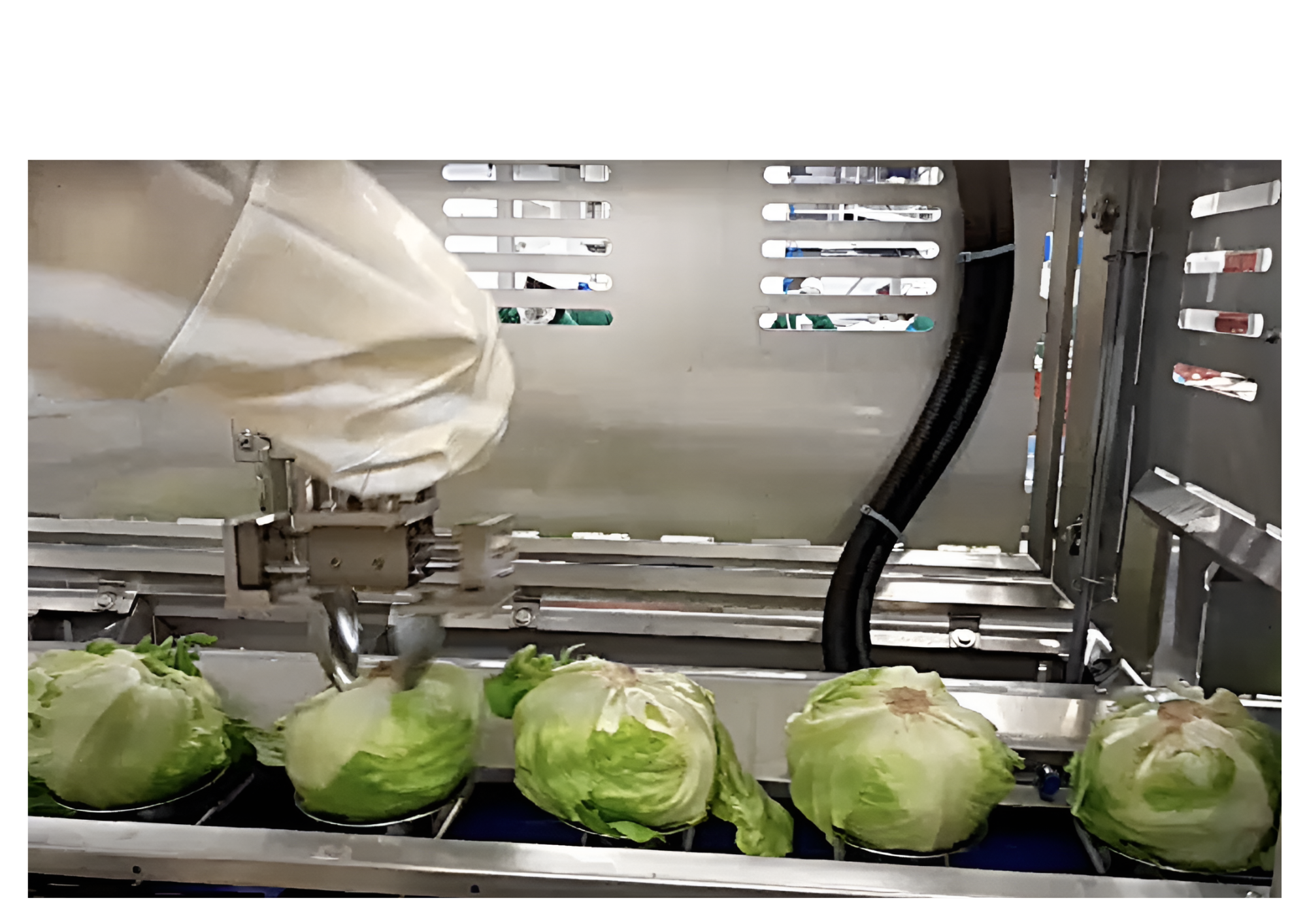
Our 3D vision enabled robotic de-corers use advanced positioning to map the exact density of every individual head of lettuce. The mechanical blade de-cores with exact, repeatable depth - extracting 100% of the waste core, while achieving up to a 97% product yield.
Over a multi-decade operational lifespan, that hyper-optimized yield pays for the entire processing line multiple times over. Industrial profitability isn't gained in a cheap initial purchase price; it is found in maximizing product yield hour after hour, year after year.
3. The Scalability Math: Consistency at 55 Heads Per Minute
When your facility operates at large scale, small processing inefficiencies multiply into massive losses remarkably fast.
Processing 55 heads of lettuce every single minute highlights the stark operational divide between human labor variables and mechanical certainty.
The Reality of the Manual Line
To match a target of 55 heads per minute, a manual processing line requires a large, rotating crew of operators. The human baseline sits at roughly 6 heads per minute, so to hit peak throughput, you stack the line with a massive team just to keep up.
At that extreme, human fatigue is inevitable. Hands get tired, the pace and precision drops and even a minor 3% to 5% drop in product yield from human over-coring means - you’re throwing thousands of heads of perfectly good product into the waste bin every hour.
When you calculate wages, general overhead, and high turnover, manual labor becomes an unpredictable liability on the balance sheet.
The Power of a 55-Per-Minute System
Compare that to a single automated robotic de-coring system. One single system matches that entire 55 heads-per-minute pace effortlessly. While a human maxes out around 6 heads per minute, the machine operates with absolute consistency.
Because it never slows down, never suffers from late-shift fatigue, and never makes a lazy cut, this consistent through-put vastly outpaces a human crew over a standard shift.
For large-scale operations looking to completely transform their processing capacity, deploying a bank of 4 automated systems side-by-side matches the highest throughput demands in the industry today.
Reclaiming lost product yield, drastically shrinking floor footprint, and converting a fluctuating labor market into a predictable, high-margin asset.
The Reality of Automation
An automated robotic de-coring system locks in that throughput of 55 heads per minute. There’s no slow down, no late-shift fatigue, and the system cuts with the exact same surgical accuracy on head number 40,000 as it did on head number 1.
By reclaiming that lost 5% or more of product yield and consolidating your multi-person trimming crew down to a bare minimum, the equipment rapidly pays for its own initial capital expense. Within months of deployment, the system transitions from a capital expense to a pure margin driver, flowing recovered revenue straight back to your bottom line.

4. Absolute Bio-Security and Zero-Tolerance for Recalls
A single pathogen outbreak or foreign object discovery can instantly obliterate a food processing brand that took decades to build. The food service market doesn't forgive contamination. If your equipment uses complex, hard-to-sanitize plastic pockets or hidden niches where bacteria can fester, your facility is a ticking time bomb.
Extractacore cells are engineered completely from food-grade stainless steel. To a high hygiene standard with no hard to clean areas.
Incorporating these foundational sanitary principles set high standards in food safety and provides an additional shield for your brand liability.
5. Leveraging the Safety of Industry Standards
When buying high-volume equipment, the dominant players in fresh-cut processing don't take risks on unproven setups. They know Extractacore can deliver industry-standard, proven systems engineered to survive supply chain crises and economic shocks.
Protect Your Line and Secure Margins with reliable technology that has proven it can handle the pressure.
Contact our team to claim your custom throughput analysis.