Stop Chasing Speed: The 20% Yield Loss Hidden in Hand Trimming
Every Processor Measures Speed.
Almost nobody measures consistency.
Walk onto any fresh produce processing floor and the numbers dominate every conversation.
Heads per minute. Production targets. Line efficiency. Downtime.
Speed matters because every processor lives by throughput. Contracts depend on it, labour planning depends on it and every downstream process relies on a steady flow of product.
But speed has become so visible that many processors overlook the number with the greatest influence on profitability.
Yield.
Where hand trimming produces an average usable yield of 80%, approximately 20% of the incoming crop leaves through the trimming process.
On an average 500 g lettuce, that represents 100 g removed from every head.
Across an example line processing 79.2 tonnes of lettuce during two 8-hour shifts, an 80% hand-trimming yield sends approximately 15.84 tonnes into the waste stream every day.
Extractacore reduces trimming loss to approximately 3 - 4%.
On the same volume of crop, that means approximately 2.38–3.17 tonnes in real waste, rather than 15.84 tonnes of over-trim.
The difference is approximately 12.67–13.46 tonnes of additional usable product retained every production day.
That is the commercial value of precision.
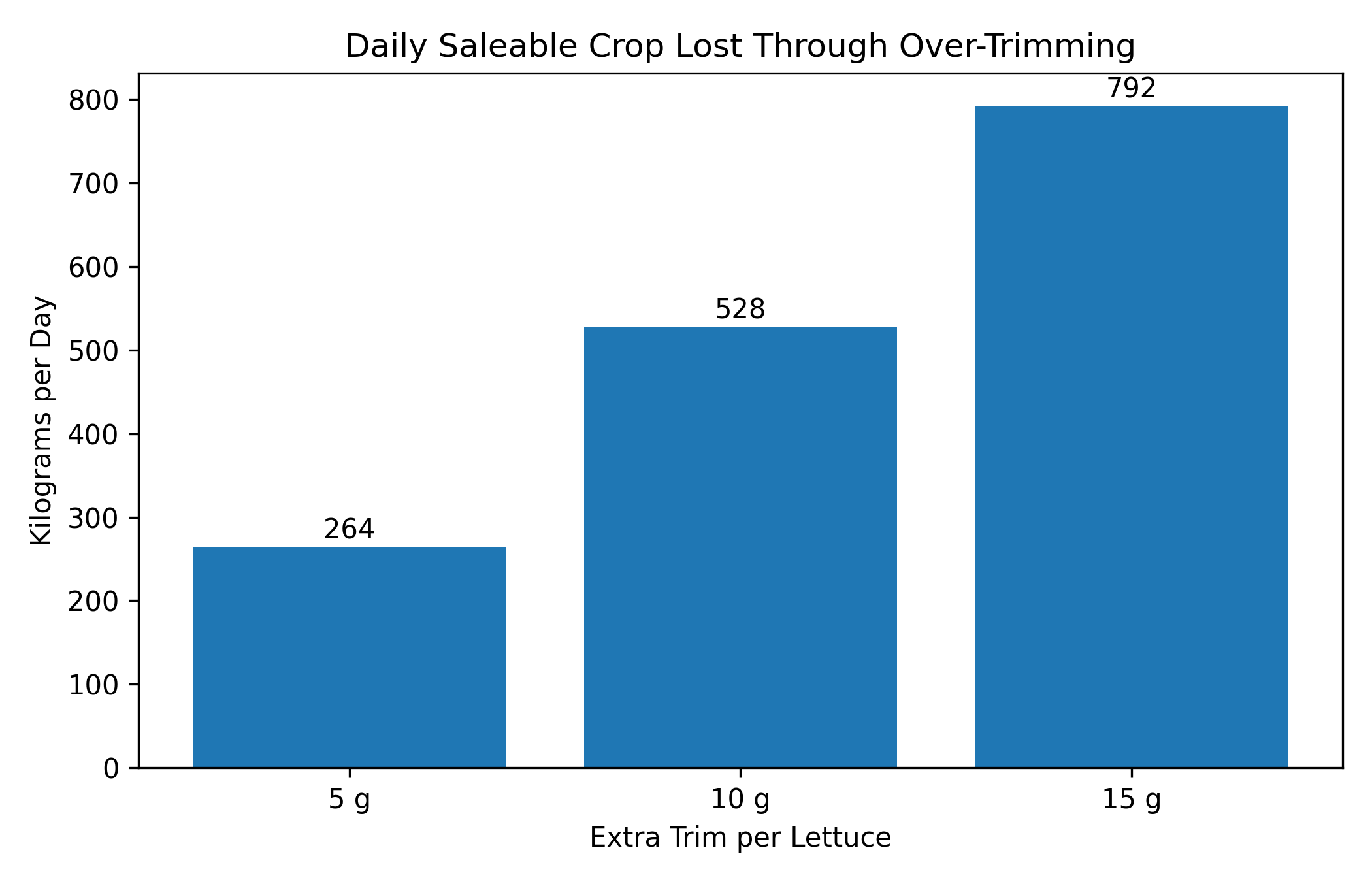
Small trimming differences create significant commercial losses at production scale. Removing just 5 grams more than necessary from each lettuce can result in approximately 264 kilograms of saleable product being discarded during a two-shift production day.
Labour Appears on the Balance Sheet
Yield loss does not.
Most processors know their labour costs to the nearest penny because payroll is measured every week.
Yield loss disappears gradually.
Every unnecessary cut removes value that has already been purchased, handled and processed.
The crop has already been planted, irrigated, harvested, cooled, transported, inspected and delivered before it reaches the trimming station.
When saleable leaf leaves with the core, the business loses material whose full supply-chain cost has already been incurred.
Because the loss happens one lettuce at a time, it becomes normal.
Overflowing waste bins become familiar and operators become accustomed to the amount being removed. The distinction between unavoidable core waste and saleable product lost through over-trimming disappears.
That is why labour is frequently used as the first justification for automation.
The larger return can sit inside the yield difference.
Moving from an 80% usable yield to 96–97% means retaining an additional 16–17% of the incoming crop.
On 79.2 tonnes of daily production, that represents approximately 12.67–13.46 tonnes of additional usable product.
The machine does not create more crop.
It allows more of the already paid for crop to reach the customer.
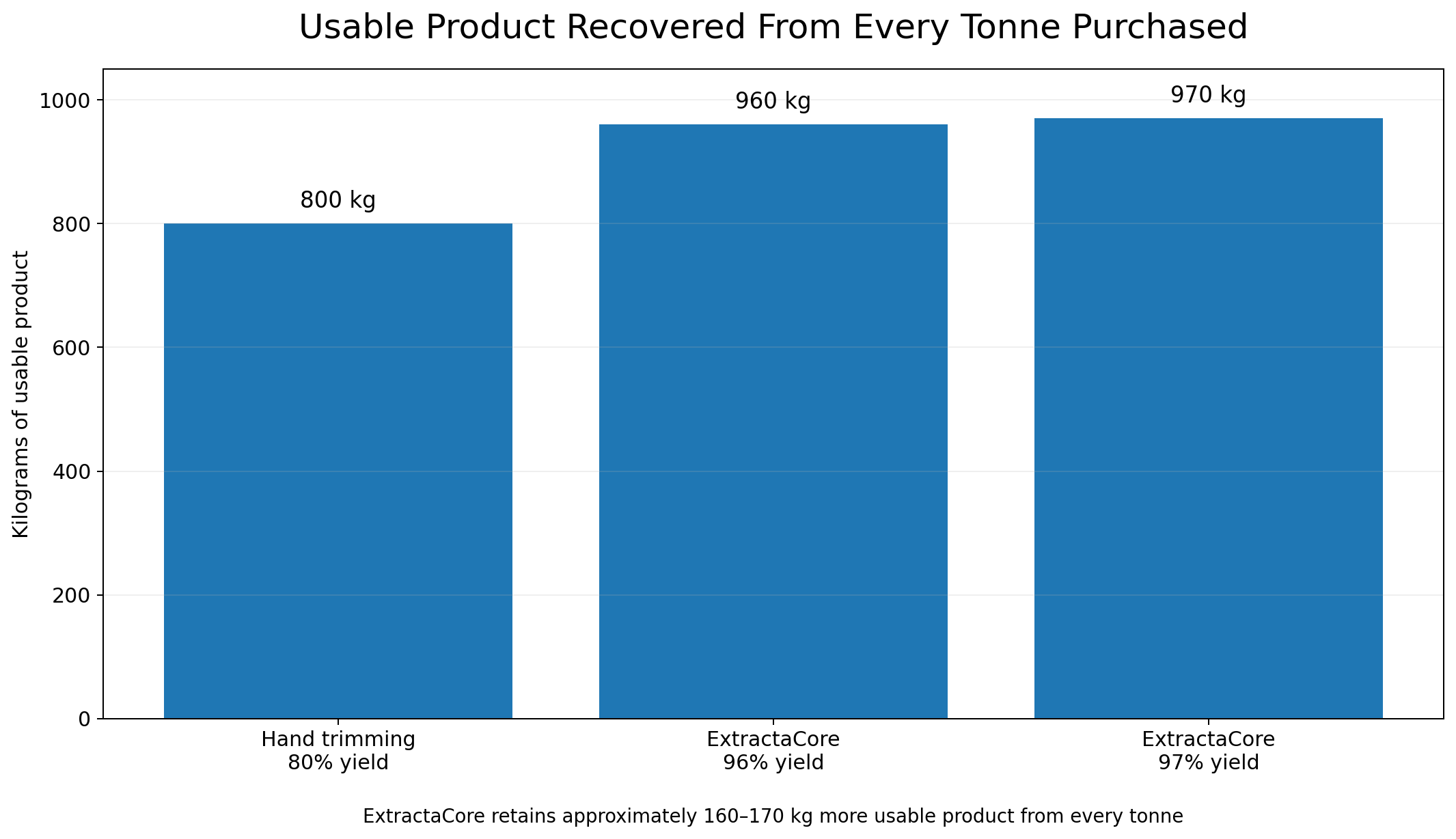
ExtractaCore retains approximately 160–170 kg more usable lettuce from every tonne purchased compared with an 80% hand-trimming yield.
Precision at Speed Changes the Economics
For way too long, processors have accepted an uncomfortable compromise.
Move faster and remove more product or slow down and recover more yield.
Robotics with intelligent vision changes that equation.
Instead of assuming every lettuce is identical, the system measures the shape, diameter, orientation and core position of each individual head before the cut is made.
Every cutting decision is based on the crop in front of the machine at that moment rather than the habits of the operator.
That allows high-speed de-coring while maintaining consistent cutting accuracy throughout the production day.
The first lettuce receives the same precision as the hundred-thousandth.
Machines don’t become tired, cautious or hurried and they don’t increase the cutting margin as the shift progresses. They do not change technique when one operator replaces another.
This is where the economics change.
At an 80% usable yield, every tonne of incoming lettuce produces approximately 800 kg of finished product.
At a 96–97% usable yield, the same tonne produces approximately 960–970 kg.
The processor gains between 160 and 170 kg of additional usable product from every tonne purchased.
Across 79.2 tonnes of incoming crop, that becomes approximately 12.67–13.46 tonnes per day.
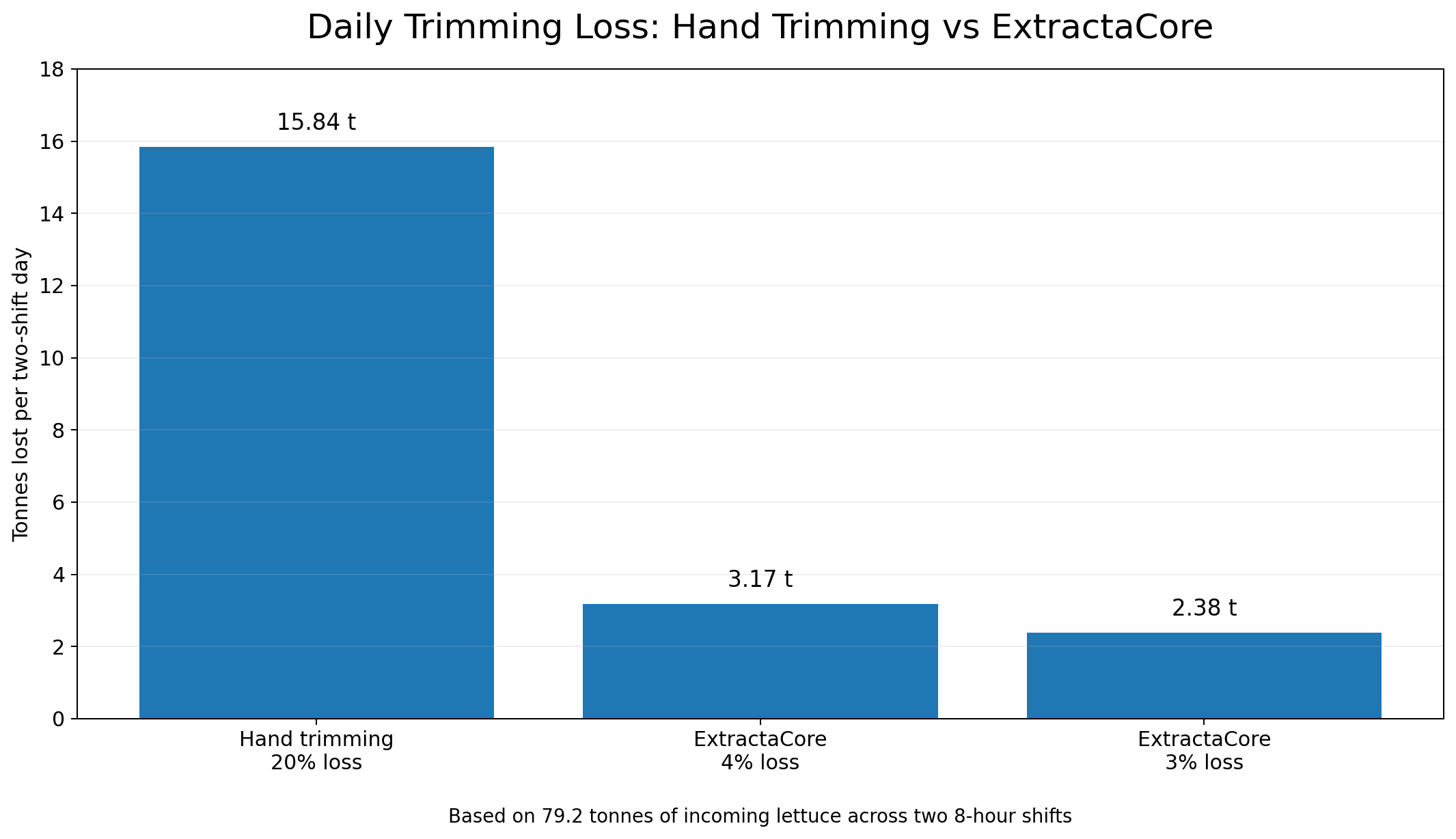
Reducing trimming loss from 20% to 3–4% retains approximately 12.67–13.46 tonnes of additional usable lettuce during each two-shift production day.
The Crop Is Variable
Your process does not have to be.
Fresh produce is naturally inconsistent. Every lettuce has a different shape, every core sits at a different angle and every field produces variations in size, density and condition.
Processors can’t fully standardise the crop. But they can control how consistently their operation responds to it and that distinction is one of the greatest competitive advantages available in fresh produce processing.
Natural variation requires the cutting decision to adapt.
Process variability allows the amount removed to depend on the judgement, confidence and fatigue of the person making the cut.
Every manual operator develops a slightly different technique.
Fatigue changes judgement, safety margins increase and shift changes introduce another interpretation of the correct cut.
Those differences appear minor when one lettuce is inspected.
Across an entire production day, they determine whether the processor retains 80% of the incoming crop or 96–97%.
The difference is no longer just a few grams - It is a vastly different production result.
Five Grams Never Looked Expensive
Five or ten grams of unnecessary trim disappears in your hand.
Nobody stops production and nobody writes a report about five or ten grams.
The problem with that example is that it understates the real commercial difference.
Where hand trimming loses approximately 20% and Extractacore reduces the loss to 3–4%, the yield gap is 16–17 percentage points.
On a 500g head of lettuce:
80% usable yield = 400 g usable product — hand trim
96% usable yield = 480 g usable product — Extractacore
97% usable yield = 485 g usable product — Extractacore
That means ExtractaCore retains a higher percentage of usable product from every incoming lettuce, increasing usable yield by 16–17 percentage points compared with hand trimming.
Across a full production year, the cumulative recovery can run into several thousand tonnes of saleable crop.
These figures do not represent additional throughput - They represent more product recovered from the same incoming crop.
No additional fields.
No additional harvesting.
No additional transport. (Less transport for waste).
More of the crop reaches the customer instead of the waste stream.
Annual recovery depends on the number of days a processor operates, so any yearly figure should be treated as an illustration rather than a universal result. At the current measured yield difference, Extractacore retains approximately 12.67–13.46 tonnes of additional usable lettuce per two-shift production day. A site operating 200 days per year would retain approximately 2,534–2,693 tonnes, while a 300-day operation would retain approximately 3,802–4,039 tonnes. The daily figure is the constant. The annual value depends on the processor’s own production calendar and average throughput.
Annual Product Retained at Different Production Schedules
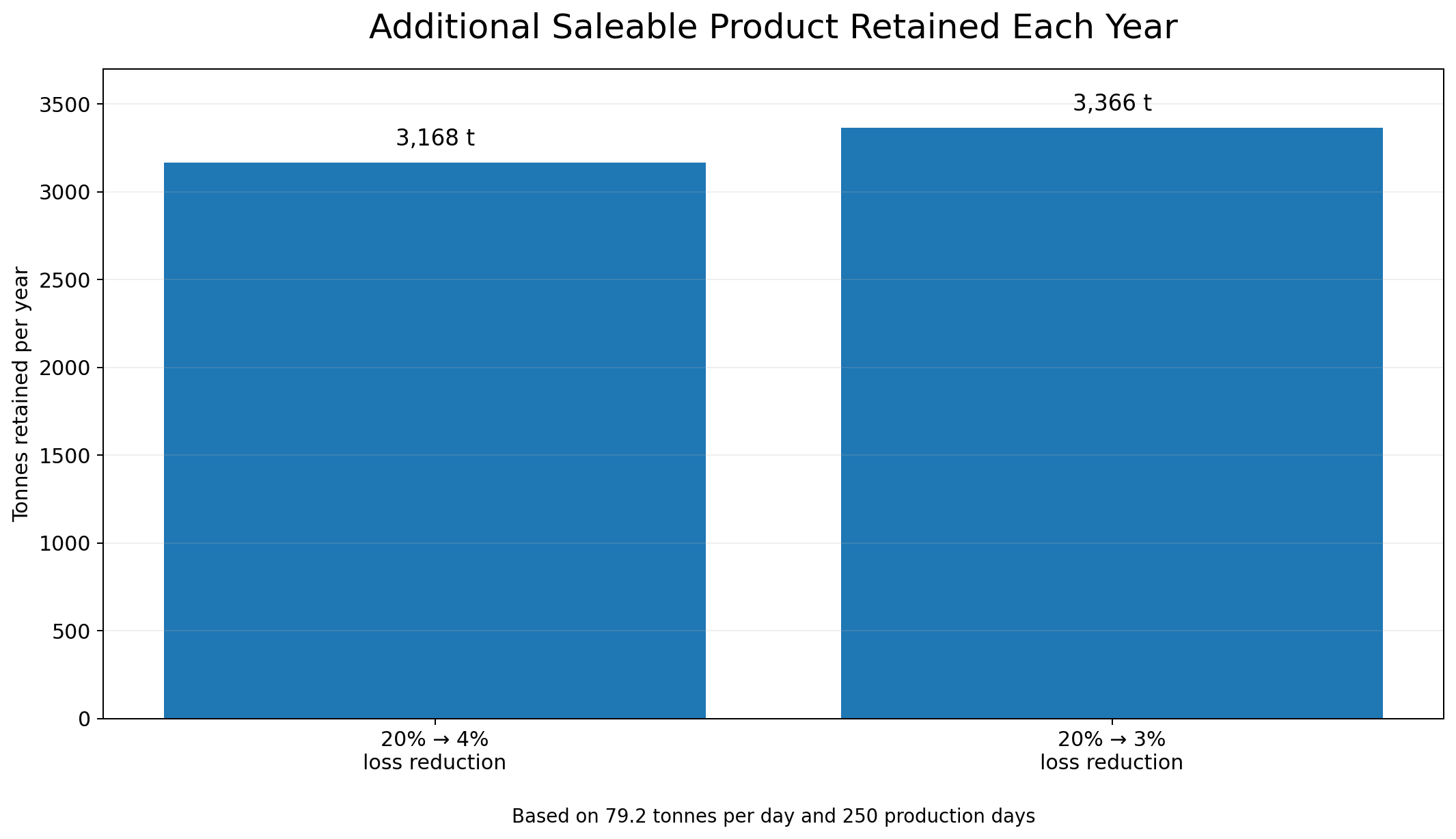
Improving usable yield from 80% to 96–97% retains approximately 3,168–3,366 additional tonnes of saleable lettuce across 250 production days.
Consistency Compounds
Processors frequently ask how fast the robotic de-coring system can run. It’s 55 heads per minute - We have speed.
More importantly we have accuracy and consistency - Here’s what happens during every cut.
Each head is assessed individually, the core position is located in milliseconds and every cut is adapted to the lettuce in front of the machine.
Every action is repeated without the variation introduced by fatigue, judgement or shift changes.
Consistency produces higher yield - It also stabilises downstream packing because product arrives in a more uniform condition.
It improves presentation because the cut is repeated to the same standard, reduces rework and unnecessary handling.
Forecasting can be improved because the processor has greater confidence in how much finished product will be produced from each pallet.
Production planning is further supported because output is not dependent on the performance of individual operators.
That confidence has great commercial value.
Speed Wins Contracts
Consistency protects margins.
Every processor wants faster production, and the processors creating long-term advantage want something more valuable.
Predictability.
When every pallet produces a more consistent yield, planning becomes easier.
Customer specifications become easier to meet.
Labour requirements become easier to forecast.
Finished volumes become more reliable.
Margins become easier to protect.
Speed determines how quickly the crop moves through the line.
Consistency determines how much value remains when it leaves.
From Process Consistency to Commercial Predictability
The commercial value of consistency extends beyond the production line.
Unnecessary variation affects yield, product presentation, labour efficiency and production planning. Individually, these differences appear insignificant. Across an entire season, they become measurable commercial outcomes.
Reducing process variability gives processors greater confidence because production becomes more predictable.
Higher raw material yield means more of every field run reaches the customer, repeatable cutting accuracy improves presentation while reducing unnecessary handling.
Stable throughput simplifies production planning and improves delivery performance.
Consistent output provides greater confidence when forecasting production, labour requirements and finished volumes.
The crop will always vary - Your process does not have to.
When consistency becomes repeatable, profitability becomes predictable.