The Economics Of A Millimetre
Most processors don't lose money because of catastrophic mistakes.
They lose money because of small decisions.
A little extra trim.
A slightly deeper cut.
A process variation nobody notices.
A few millimetres that seem too insignificant to matter.
Until they are repeated thousands of times.
Fresh produce processing is an industry built on scale.
What appears insignificant on one lettuce can become substantial when multiplied across an entire season.
This is the economics of a millimetre.
Why Small Differences Matter
Imagine placing two trimmed lettuces side by side.
To the eye, they look almost identical.
One has had slightly more product removed than necessary.
The other has been processed more precisely.
Most people would struggle to notice the difference.
Yet the difference exists.
And more importantly, it compounds.
This is one of the reasons yield can be difficult to manage.
The losses are rarely dramatic.
They're incremental.
The challenge isn't seeing the loss on one lettuce.
It's recognising the loss across millions.
Repetition Changes Everything
Most industries experience variation.
Fresh produce processing amplifies it.
Because the same action is performed repeatedly.
Thousands of lettuces.
Every shift. Every week. Every season.
A small difference multiplied by enough repetitions becomes a significant number.
This is why seemingly minor process improvements can deliver surprisingly large financial returns.
Because it is consistent.
Consistency compounds.
So does waste.
The Human Element
Operators perform one of the most difficult tasks in processing.
They make decisions in real time.
Product size changes.
Core position changes.
Crop quality changes.
Every lettuce presents slight variation.
The objective is simple.
Remove the core.
Protect product quality.
Maintain throughput.
The challenge is that consistency becomes difficult when variability increases.
Some cuts become deeper than necessary.
Some become more conservative.
The variation is understandable.
But variation has a cost.
Why Yield Loss Is Often Invisible
Labour is visible.
Waste bins are visible.
Machinery is visible.
Yield loss often isn't.
The product removed during processing rarely receives attention because it disappears immediately.
Nobody invoices it.
Nobody reports it separately.
Nobody sees it leaving the business.
The crop was purchased.
The value existed.
The opportunity disappeared.
This is what makes yield recovery different from traditional cost reduction.
You're not reducing spending.
You're recovering value.
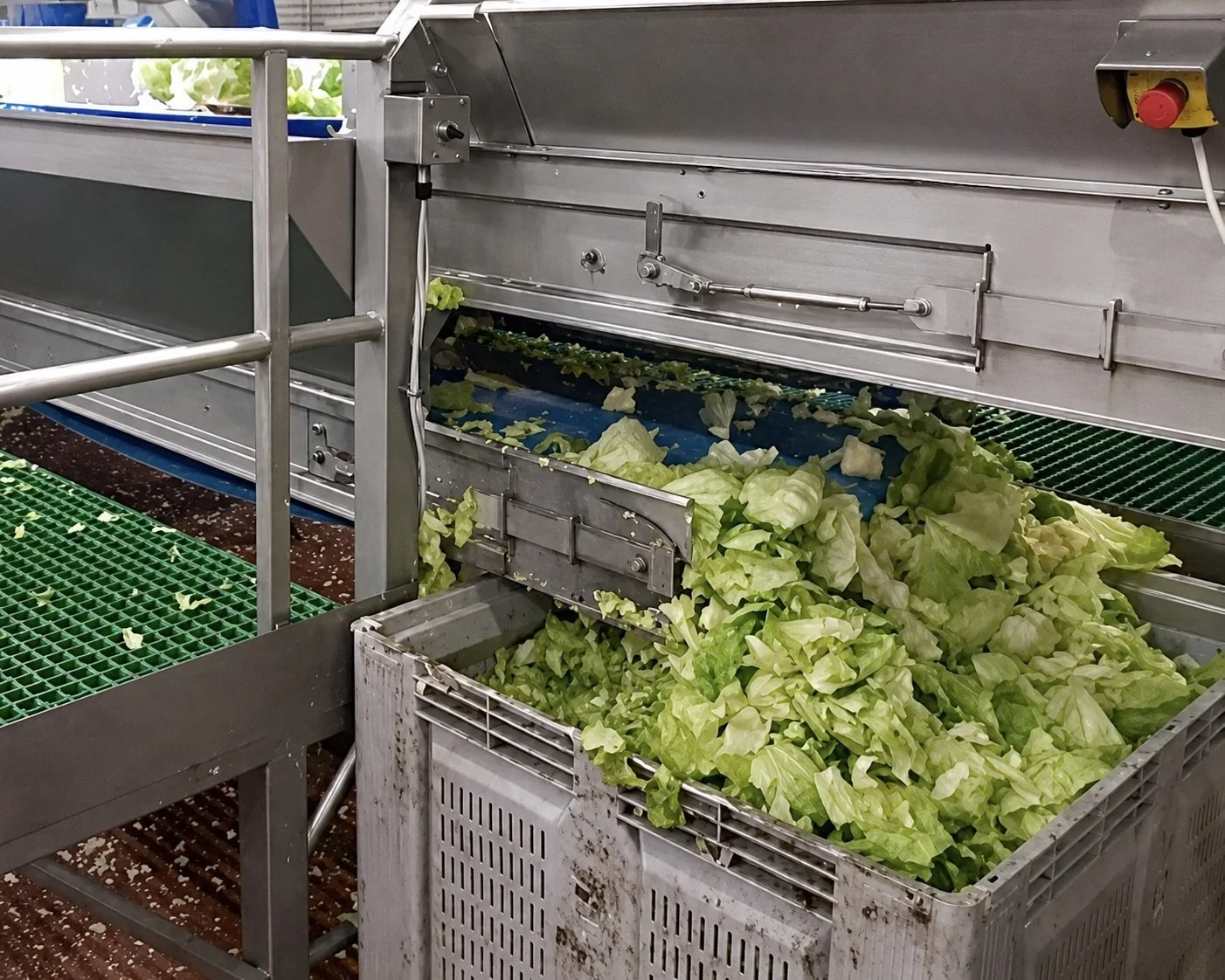
Hand trim yield loss
Precision Creates Opportunity
This is where processing technology continues to evolve.
Historically, processors accepted a degree of variation.
It was simply part of the process.
Today, there is growing interest in reducing that variation.
Because consistency is valuable.
Every reduction in unnecessary trim creates opportunity.
Every improvement in repeatability creates value.
Every millimetre retained becomes product rather than waste.
The Difference Between Good And Repeatable
Many processing lines can achieve good results.
The best processing lines achieve repeatable results.
This distinction matters.
A good outcome once is encouraging.
A good outcome thousands of times is profitable.
The highest-performing operations are rarely the ones that consistently deliver predictable results.
Consistency is where margins are protected, where confidence is built, and where value recovery begins.
Looking Beyond The Millimetre
It's all about perspective.
Recognising that some of the largest financial opportunities don't arrive as major projects.
They arrive as small improvements repeated consistently.
The processors that understand this think differently.
They ask:
"How fast are we processing?"
They also ask:
"How much value are we keeping?"
Because every millimetre removed unnecessarily represents lost value.
And once it's gone, it can never be recovered.
The Bigger Picture
The economics of a millimetre teaches an important lesson.
Small decisions matter, because they are repeated.
Until something insignificant becomes something substantial.
In fresh produce processing, profitability is often influenced less by major events and more by everyday decisions.
The best processors understand that value is rarely won or lost all at once.
More often, it leaves one cut at a time.